Storage & Handling of Manual Hoists
Essential Guidelines for Portable Hoist Maintenance & Longevity
Proper Storage Chain Protection Corrosion Prevention
Properly storing and handling your manual and portable hoists when they are not in use is critical to avoiding structural damage and keeping the equipment perfectly fit for service. Follow these manufacturer-approved guidelines to protect your investment and maintain workplace safety.
The Life-Extension Guide
Hoists are made of steel, and steel hates moisture. Adhering to strict storage and handling protocols ensures your equipment is always ready for the next lift.
🏭 Storage: The Battle Against Corrosion
- Keep it High and Dry: Always store hoists in a clean, dry area, preferably on a dedicated rack or pegboard. Storing a chain block on a damp workshop floor is a recipe for a "seized" internal brake.
- Hang it Up: Do not leave hoists in a tangled heap. Hanging them by the top hook allows the chain to stay straight and prevents moisture from pooling in the housing. Ensure both the load and hand chains are off the ground.
- The "Clean Before Store" Rule: If a hoist was used in rain, mud, or saltwater, it must be cleaned and thoroughly dried before it is put away. Protect exposed metal surfaces against corrosion.
🏗️ Handling: No "Drag and Drop"
- Zero Dragging: Always carry the hoist or move it on a trolley. It might be tempting to drag a 2-ton hoist across a concrete floor by its hand chain, but this is the fastest way to damage the guide rollers, scar the housing, and bend the hand-wheel cover.
- Control the Chain: When transporting, secure the load chain so it doesn't whip or snag. A kinked chain under load is a catastrophic failure waiting to happen.
- Gentle Placement: Never drop or throw hoists. Physical impacts can misalign the internal gear mechanisms.
How to Wrap Chains for Transport
To prevent tangling and damage during transit, manually secure the chains into a compact unit using the following method:
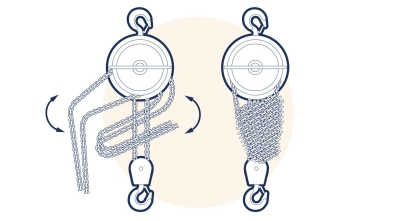
Step 1: Position the Bottom Hook
Raise the bottom hook to approximately 350–500 mm (12–18 inches) from its highest possible position (use the lower dimension for short-lift hoists, and the higher dimension for high-lift models).
Step 2: Wrap the Load Chain
Take the slack loop of the load chain and wrap it neatly around the remaining tensioned chain located between the hoist body and the bottom hook.
Step 3: Wrap the Hand Chain
Take the hand chain loop and wrap it securely over the previously coiled load chain.
Step 4: Secure the Unit
Tie the ends off securely with twine or structural wire. The hoist is now a safe, compact unit ready for storage or transport.
Technical Maintenance: The "Smooth Move" Checklist
| Component |
Maintenance Action |
Frequency |
| G80 Load Chain |
Clean with a wire brush and apply light machine oil. |
Monthly / After wet use |
| Brake Discs |
Keep strictly dry and free of oil/grease. |
During annual service |
| Hooks & Latches |
Check for stretch or deformation; lubricate the swivel point. |
Pre-use and Post-use |
| Gear Case |
Visually inspect for cracks or missing fasteners. |
Quarterly |
🚨 Critical Lubrication Note
Never allow oil or grease to come into contact with the friction discs (brake pads). Lubrication is strictly for the load chain and gears only. A greasy brake is a non-functional brake, which will lead to uncontrollable load drops.
⚠️ Operational & Modification Warnings
Multi-Fall Hoists: Never turn or flip the bottom block over through the chain falls. Doing so will dangerously twist the load chain, causing it to jam or break under load.
Unauthorized Modifications: For non-portable hoists used outdoors, use a suitable weather cover and protect the chains from corrosion. However, you must never galvanize or plate chains or any other load-bearing parts unless the manufacturer has explicitly approved the exact process in writing.


