
The H-Lift Hydraulic Long Chassis Floor Jack (FJL type) is built for workshop lifting tasks where a long-frame jack is preferred for improved access and handling. It is intended for controlled lifting on stable ground with proper support practices.
The FJL Series Long Chassis Jack is the ultimate heavy-duty tool for commercial vehicle workshops. With capacities ranging from 3T to 20T and an extra-long chassis, it reaches lifting points deep under trucks, buses, and agricultural machinery that standard jacks cannot access.
Features an Extra-Long Chassis specifically designed to reach lifting points deep under vehicle bumpers. High lifting range (up to 680mm) for high-chassis vehicles.
Equipped with a Foot Pedal that quickly raises the saddle to the lifting point without load. The handle locks in 3 Positions (horizontal, 45°, vertical) for easy maneuvering.
Available in 3T, 5T, 10T, and 20T capacities. Features welded hydraulic pumps and Chrome Plated Rams to resist rust and ensure longevity.
Includes Overload and Bypass Safety Valves to prevent using the jack beyond its rated capacity or over-extending the ram.
| Item No. | Capacity | Min. Height | Lifting Range | Max. Height | Weight | Product Code |
|---|---|---|---|---|---|---|
| t | mm | mm | mm | kg | ||
| FJL-03A | 3 | 140 | 520 | 660 | 56 | 808004103 |
| FJL-03 | 3 | 140 | 480 | 620 | 70 | 808004003 |
| FJL-05 | 5 | 160 | 400 | 560 | 86 | 808004005 |
| FJL-10 | 10 | 170 | 400 | 570 | 126 | 808004010 |
| FJL-20 | 20 | 220 | 460 | 680 | 215 | 808004020 |
Jacks may be hydraulic or mechanical in operation and are available in a wide range of capacities and designs. Proper selection is critical for safety.
Multiple Jacks: Most operations require multiple jacks. It is impossible to raise/lower them in perfect unison, causing uneven loading. Ensure jack capacity is adequate to handle load transfer. Keep the load level.
Floor Stability: Ensure the floor can withstand the point load. Use floor plates to spread the load if necessary. Avoid buried cables or pipes.
Contact: The jack head must be in full, firm contact with the jacking point. Use packers to prevent slipping.
Store jacks upright with the ram/rack/screw fully lowered to protect them from damage. Remove handles/levers and store separately. Never store damaged jacks.
Clean jacks regularly to remove dirt from racks, screws, and seals. Check hydraulic oil levels. Lubricate moving mechanical parts.
Defects to Watch For:
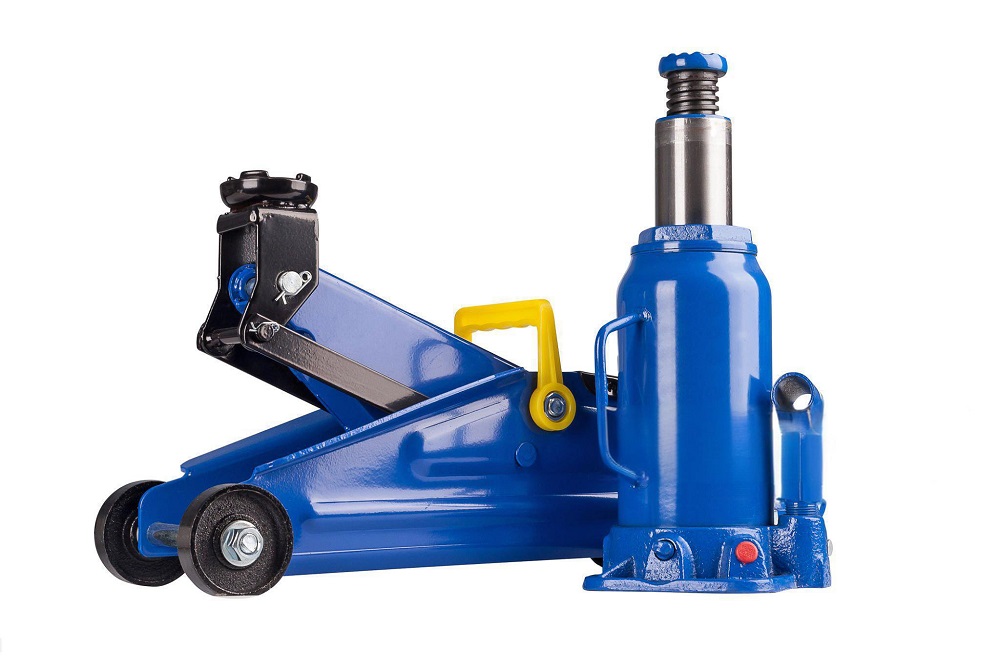
A hydraulic floor jack is a heavy-duty lifting device designed to be positioned horizontally on the ground. Unlike vertical bottle jacks, floor jacks feature a horizontal frame with wheels, offering superior maneuverability and ease of positioning under vehicles.
Common Applications:
Many modern models feature a dual pump piston system, which utilizes both the upward and downward strokes of the handle to lift the load faster than traditional single-pump jacks.
Specialized low-profile models are available to fit under sports cars or vehicles with low ground clearance, while High Lift versions provide extra height for trucks.
Equipped with rear swivel casters and a long handle, allowing for precise positioning of the lifting pad under the vehicle's designated lift points.
The lifting pad often rotates 360 degrees, allowing for secure contact with the vehicle chassis regardless of the approach angle.
To prevent accidents and equipment failure:
Regular maintenance extends service life:
| Model Type | Capacity | Min. Height | Max. Height | Application |
|---|---|---|---|---|
| Low Profile | 2 - 3 Ton | 75 mm | 500 mm | Sports Cars, Sedans |
| Standard / Garage | 3 - 4 Ton | 130 mm | 460 mm | SUVs, Light Trucks |
| High Lift | 3 Ton | 190 mm | 800 mm | Off-Road Vehicles, High Chassis |

